
Have you ever noticed the night sky playing little tricks on you? Imagine three bright planets coming together not once, but three times over a few weeks. They move forward, then back, and finally edge ahead, like they're dancing just for us. This triple planetary meetup reminds us that the sky is full of surprises. It feels like a gentle nod from the universe, inviting us to wonder at its unexpected rhythms. Let's take a closer look at this magical celestial moment together.
triple planetary conjunction Sparks Cosmic Magic
A triple planetary conjunction is a wondrous sight in the night sky when two planets, or a planet and a star, seem to come together three times over a few weeks or months. It may sound like magic, but it’s really just about the way they move from our point of view on Earth. First, the planets draw near, then one appears to move backwards for a while, and finally, they move forward again. Even though they appear so close, they are actually very far apart.
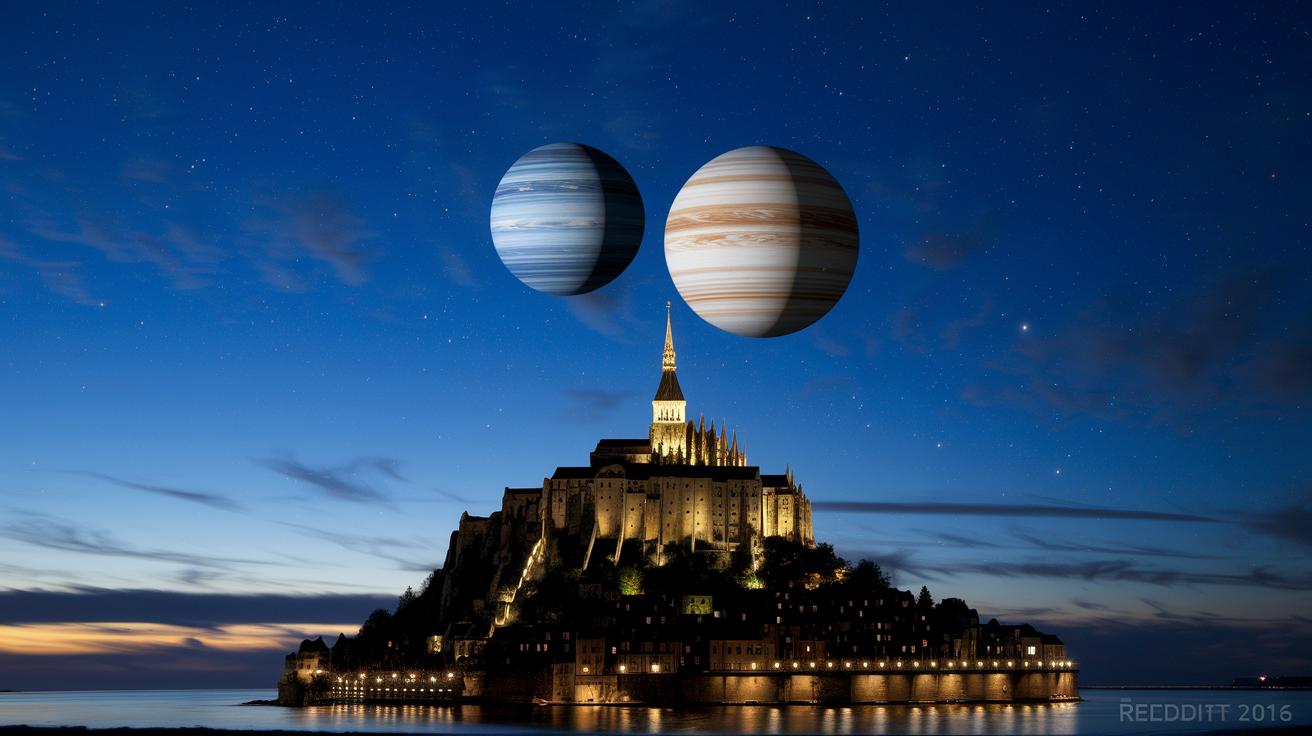
Take 2013 for example. That year, Venus, Jupiter, and Mercury came together to form a striking triangle above Mont-Saint-Michel. Pretty amazing, right? These triple encounters are so rare that they only happen a few times each decade. Their infrequent visits add a sense of wonder, as if the planets are sharing a secret with us each time they meet.
We celebrate this event not just for its beauty but also for its precise cosmic choreography. Those who keep an eye on the sky know that these repeated meetings occur due to subtle shifts in how the planets travel. In simple terms, a planetary conjunction means that the planets come close together in our sky. When it happens three times, it turns into a mesmerizing event that sparks a feeling of cosmic magic. Watching it unfold reminds us just how dynamic and full of surprises our universe truly is.
Comparing Triple Conjunctions and Other Planetary Alignments
Imagine two celestial events with distinct charm. A planetary conjunction happens when a couple of heavenly bodies seem to huddle together in the night sky. It’s quite common and usually involves just a few shining points. On the other hand, a planet parade is like a cosmic group photo, with many planets gathered closely in one area. Even though such gatherings are impressive, they don’t show that repeated pair dance you’d see in a triple conjunction.
Now, let’s explore what makes a triple conjunction so special. This event unfolds as the same two planets come close together not once, but three times. It starts when they first approach each other, then one appears to slow down or even move backward, letting them meet a second time. Finally, when they resume their normal path, they share a third and memorable close encounter. It’s a rare, almost choreographed display in the sky that leaves skywatchers in awe of the gentle dance of our celestial neighbors.
Notable Historical Triple Planetary Conjunctions
On May 26, 2013, Venus, Jupiter, and Mercury united to form a neat triangle over Mont-Saint-Michel in Normandy, France. Over a three-week period, these planets gradually approached each other until they lined up in late May, like pieces on a cosmic stage. Imagine watching the skies and feeling as if the heavens had planned a once-in-a-lifetime show just for you.
Local stargazers at the Bifrost Astronomical Observatory in southern Arizona captured this moment with their cameras. One snapshot shows the final evening scene, while another taken just a day before reveals a gentle shift in the triangle’s shape. These images not only highlight the planets’ steady movement but also the magic of their rare alignment.
For centuries, both ancient writings and modern records have noted these celestial trio gatherings. Historians point out that events like this reveal details about the mechanics of our orbits while also stirring up cultural stories and personal reflections on the wonder of the sky.
| Date | Event Details |
|---|---|
| May 26, 2013 | The triangle formed by Venus, Jupiter, and Mercury over Mont-Saint-Michel was captured with final and earlier images at the Bifrost Astronomical Observatory. |
| Historical Impact | Celestial trio gatherings have inspired both scientific insights and cultural reflections through the ages. |
Upcoming Triple Planetary Conjunction Events

Hey there, stargazer! Some exciting sky shows are coming soon. Saturn and Neptune will treat us to a rare triple meeting. It all starts on June 29, 2025, when Saturn, brilliantly bright at magnitude 0.8, passes really close to Neptune, just 0°59′ away.
Then, things get even more interesting. Both planets take a little backward loop called retrograde. Neptune turns back on July 5, and Saturn follows on July 14. When they resume their normal forward journey, Saturn on November 28 and Neptune on December 10, 2025, they meet again, with a final encounter on February 16, 2026. This full cycle gives us a unique display as their forward and backward motions create different cosmic moments.
There’s another stellar treat too. Mars and Mercury join in for a rare triple conjunction of their own. Watch as they come very close on October 19, 2025 at 20:33 GMT and again on November 12, 2025 at 18:41 GMT. These tight passes are sure to capture the attention of both seasoned astronomers and casual stargazers alike.
Here’s a handy reference to keep all the dates clear:
| Date | Planets | Motion Phase | Separation |
|---|---|---|---|
| June 29, 2025 – Feb 16, 2026 | Saturn, Neptune | Prograde & Retrograde Cycle | 0°59′ (initial) |
| Oct 19 & Nov 12, 2025 | Mars, Mercury | Close Approach Phases | Minimal Separation |
Mark your calendars. These cosmic events are a special opportunity to witness the dynamic dance of our solar system, a true treat for your eyes and spirit.
How to Observe a Triple Planetary Conjunction
Start by checking the Sky Tonight app to know when and where to look up. Pick a spot with a clear western horizon after dusk because that's when the sky grows dark and the planets shine brighter. Give your eyes about 30 minutes to adjust, like letting the night slowly unveil its secrets.
If you want to see Mercury more clearly, grab a pair of binoculars or a simple telescope. Look for nearby stars to help frame the triangle of the planets. This little trick lets you notice how they gently drift across the evening sky.
For those who love capturing the moment, try setting your camera manually. Use a 1–2 second exposure at ISO 800 and keep a tripod handy to hold your camera steady.
| Step | How to Do It |
|---|---|
| Find a Spot | Choose a location with a clear view of the western horizon |
| Give Your Eyes Time | Let them adjust for about 30 minutes in the dark |
| Enhance Your View | Use binoculars or a low-power telescope to spot Mercury |
| Set Your Camera | Manual exposure of 1–2 seconds at ISO 800 with a tripod |
Enjoy the wonder of this rare triple display. Let each step fill you with a sense of magic as you gaze into the smooth, starlit night.
Astrological Significance of Triple Planetary Conjunctions

Astrologers believe that when two big planets meet three times, it can mark a powerful turning point in our lives. These rare meetings shine a light on aspects like our daily routines, our deeper beliefs, and even how we connect with others. Imagine the gentle shimmer of starlight inviting you to reconsider your path. For example, when Saturn and Neptune come together in a triple union, many see it as a chance to rethink both our commitments and our wildest dreams.
Many astrologers keep an eye on these events using transit charts. Think of a transit chart like a road map that shows where the planets are today and how they align with your own celestial blueprint at birth. Each time the planets come together, they offer clues about changes that might be coming in your job, relationships, or inner world. And as the planets mix their retrograde and prograde motions, their repeated meetings gently remind us that even slow changes can be really powerful.
For more details on how to read these transit charts, check out astrology transits. If you’re looking for deeper guidance on interpreting these cosmic signals, visit cosmic insights.
Final Words
In the action, we delved into the rare event of a triple planetary conjunction. We unpacked what happens when celestial bodies meet repeatedly, examined notable past occurrences, and highlighted upcoming dates.
The guide shared practical tips for observing the sky and explained the astrological meaning behind these events. Every step offered clear insights into how these cosmic patterns may shape daily life. Let this knowledge fill you with hope as the triple planetary conjunction lights up your cosmic path.