
Have you ever watched the planets put on a show just for you? There's an amazing event coming up as Mercury, Venus, Mars, Jupiter, Saturn, Uranus, and Neptune all gather close together in our night sky. Just picture the gentle shimmer of these celestial bodies, all gliding along in one narrow band. This rare grouping shows us how the dance of the planets can spark moments of wonder and invite us to pause, reflect, and feel deeply connected to the vast beauty of our universe.
Defining rare planetary alignment: causes, frequency, and visible effects
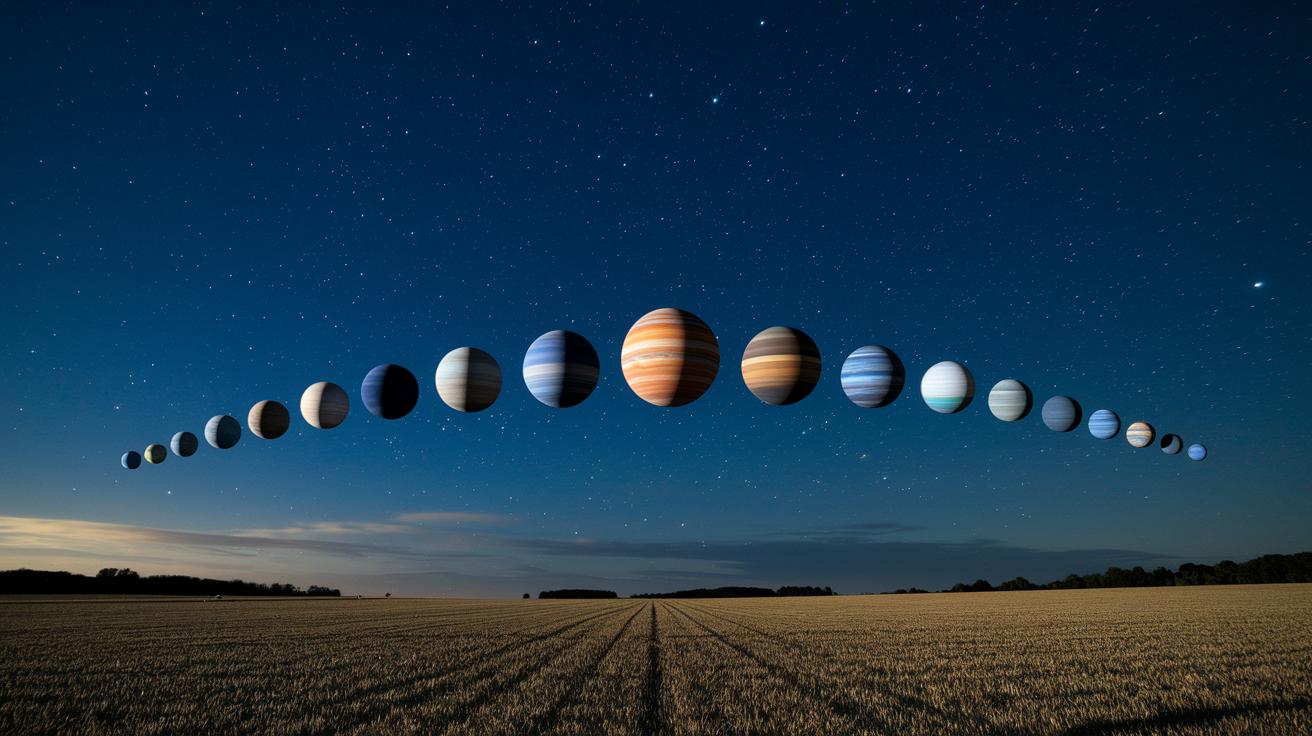
Rare planetary alignments happen when seven planets like Mercury, Venus, Mars, Jupiter, Saturn, Uranus, and Neptune seem to gather together along the same part of the sky. Imagine a special show in January 2025 when these planets get within a 10° band. They aren’t exactly lined up perfectly, but their close grouping gives the impression of a magical cosmic meeting.
This little wonder occurs because the planets move almost along the same path, called the ecliptic. Their orbits are just a bit tilted, by as much as 7°, so a perfect straight-line view is just not possible. You might notice that gatherings of five planets tend to pop up roughly every decade. In fact, there’s a six-planet event coming on February 28, 2026, and a seven-planet treat is expected on February 3, 2034. Imagine watching a sky painted with sparkling dots over several nights.
When you look up, you’ll see many bright "stars" grouped in one spot. Even though these clusters don’t change gravity or do anything big, they remind us that we’re part of a vast, rhythmic universe. Have you ever stopped to watch such a scene, feeling each planet’s gentle glow like dots in a well-practiced light show?
Each of these rare planetary alignments offers a special moment to pause and wonder. Even if it lasts only a little while, watching the planets come together kindles a sense of awe and invites you to think about your own journey among the stars.
Orbital mechanics of rare planetary alignments: the science behind the convergence
The way planets line up is all about the gentle tug of gravity nudging them off their usual paths. Instead of simply following a flat, predictable track, a big planet like Jupiter can push nearby orbits into slightly different speeds and directions.
When we look at something called the synodic period, it helps us see these shifts more clearly. The synodic period is just a way to measure the difference in how fast two planets go around the sun. Think of it like a race where a small change in pace makes a big difference in who catches up with whom. The formula, 1/S = |1/P1 – 1/P2|, shows that even a tiny tweak in speed can change when planets appear to meet.
| Planet Pair | Synodic Period Concept |
|---|---|
| Mercury – Earth | S = 1/|1/Pₘ – 1/Pₑ| |
| Venus – Earth | S = 1/|1/Pᵥ – 1/Pₑ| |
The push and pull between planets doesn’t just set the timing for when we see them align. It also adds extra twists that make predicting these events a bit tricky. This careful, number-based look gives us a real feel for why these special multi-planet moments are so rare and exciting.
Observing rare planetary alignments: tips, tools, and timing
Have you ever watched the sky an hour after sunset? As dusk turns into dark, you'll notice Jupiter and Saturn rising high by 10 PM, while Venus and Mercury linger near the horizon. This rare planetary gathering takes some careful timing, but a bit of planning makes it feel like pure magic.
For the best view, try finding a spot away from city lights, a quiet, dark field with a clear horizon works wonders. In such places, the sky looks fuller and livelier. Binoculars can also be a great help if you want to see Uranus and Neptune in the distance. I remember one clear night when my binoculars turned each planet into a sparkling gem in the cosmic sea.
If you're planning to capture this celestial show, set your camera right. Use a wide-angle lens, set your ISO between 800 and 1600, and experiment with 15–30 second exposures to pick up those faint starry glows. A sturdy tripod and a remote shutter release can help you keep your images crisp and clear. Plus, an app like Star Walk 2, with its handy Planet Walk tool, can show you exactly when each planet rises and sets based on your location.
Don’t forget to check the weather beforehand. Look for nights with low humidity, little haze, and a steady atmosphere. This kind of planning turns a casual glance at the sky into a truly unforgettable cosmic journey. Take breaks to rest your eyes, adjust your settings as the night deepens, and enjoy every moment of this rare celestial dance.
Timeline of rare planetary alignments: past occurrences and upcoming events

Back in August 2002, a rare sight graced the night sky when five planets aligned. Sky watchers were amazed as tiny flashes of brightness and gentle color shifts caught their eyes. One observer recalled that on a crisp August night, the five shining planets gleamed with a clarity that even today’s cameras find hard to match.
Scientists saved detailed records from that evening. They measured how each planet’s glow changed as the hours passed, which later helped refine the way we track these celestial bodies. These careful observations added practical insights to future planetary studies.
Today, experts blend those early reports with new findings. Modern sensors now capture subtle brightness differences and precise placements of the planets, details that early observers could only guess at. It’s like having the best of both worlds: historic observations paired with current technology.
Recent studies show that the patterns seen in past events still guide today’s predictions. While many talk about upcoming planetary alignments, advanced data collection now gives us a deeper understanding of these rare cosmic displays. It’s a reminder that our view of the heavens keeps evolving, much like the ever-changing dance of the planets in the sky.
Cultural and experiential significance of rare planetary alignments
Long ago, ancient stargazers like the Babylonians and Chinese astrologers would study the skies for signs. They saw groups of bright planets coming together as messages about a good harvest, changes in leadership, or even hints of conflict. When several shining planets gathered close by, it was both a magical and cautious signal that things were about to shift.
Today, modern astrology keeps this tradition alive. People believe that these rare alignments can bring a big change in the collective energy, giving us a chance to look inside ourselves and find our true purpose. Many of us join group stargazing events or set intentions during these times. Crystals like amethyst, citrine, and black tourmaline are often used to focus our energy and boost the gentle cosmic vibes. This shared experience shows that even when science explains how the stars work, there is still a warm magic in these moments that connects us to the mysteries of the cosmos and our inner guidance.
Planetary energetic signatures
Modern astrologers think every planet has its own energy during these unique alignments. Mercury, for example, gifts us a spark for clear talk, like a bright whisper in the night. Venus shines on our relationships with warmth and care, while Mars fires us up to take bold steps. Jupiter opens doors for growth and new adventures, and Saturn brings a steady sense of order. Uranus reminds us that life is full of surprises, and Neptune lights our inner world with deep intuition and creative ideas. Each planet adds its own special note to the cosmic tune, helping us align our everyday lives with the wonder of the stars above.
Final Words
In the action, we explored how a rare planetary alignment happens and what you can actually see in the sky. We learned about orbital mechanics, how each planet plays its part, and saw the timeline of past and future gatherings. Tips on when to watch and capture these cosmic events gave you practical steps to follow. Ancient wisdom meets modern observation here. The energy from a rare planetary alignment invites fresh perspectives and renewed hope as you step into each new day.
FAQ
What is the rare planetary alignment?
The rare planetary alignment refers to several planets appearing closely together along the sky as they share a similar orbital plane, creating a striking visual cluster for stargazers.
When was the last time all the planets aligned?
A complete alignment of all eight major planets never happens due to their differing orbits. Recent events have featured partial groupings, like a five-planet cluster seen earlier in the 2000s.
What does NASA say about rare planetary alignments?
NASA describes these events as captivating displays resulting from the close grouping of planetary orbits. They emphasize that such alignments have no measurable gravitational influence on Earth.
When is the next rare planetary alignment expected?
The next major event features a seven-planet grouping from January 25 to February 2025, with additional groupings expected in February 2026 and another seven-planet assembly in 2034.
What is the spiritual meaning of the 2025 planetary alignment in astrology?
The 2025 alignment carries a spiritual message of enhanced collective energy and personal insight, inviting us to set heartfelt intentions and reflect under the softly shimmering night sky.
What was special about the rare planetary alignment in 2022?
The 2022 alignment showcased a notable clustering of visible planets, offering enthusiasts a memorable celestial display even though its configuration differed from the larger multi-planet events predicted for future dates.
What does the term “planetary alignment” mean?
The term describes the visual clustering of several planets in a narrow area of the sky due to shared orbital planes, which often inspires fascination and reflective wonder among skywatchers.
How rare is the 2025 seven-planet alignment?
The 2025 event is unique, featuring seven planets closely grouped—a configuration that occurs much less frequently than smaller gatherings, marking it as an extraordinary sight in our skies.
What will observers see on January 25, 2025?
On January 25, 2025, observers can expect a vibrant display with seven major planets grouping along the sky, inviting casual and dedicated stargazers alike to witness this impressive celestial parade.