
Have you ever noticed how the planets seem to dance around the Sun? They move in a steady rhythm, each following the pull of gravity, a burst of momentum, and even the speed they started with. The mass of the star plays its part too.
Today, we're going to explore how these forces team up to shape the paths of Mercury, Venus, Earth, and Mars. We'll break these cosmic rules into easy parts so you can see how the soft dance of celestial bodies keeps our solar system in a lovely balance.
Planetary Orbits Fundamentals: Mechanics of Celestial Motion
Orbital mechanics is all about how planets travel around stars. Think of it as the set of cosmic rules that keeps a planet twirling around its star. Four main factors shape this dance: the pull of gravity, the planet’s own momentum, its starting speed, and how heavy the star is compared to the planet.
Take our inner planets as an example. Mercury, Venus, Earth, and Mars all circle the Sun in a counter-clockwise spin. Mercury’s path is a bit more stretched with an eccentricity of 0.205, while Mars follows a slightly less elongated route with an eccentricity of 0.094. Venus and Earth, on the other hand, move along nearly perfect circles.
When a planet is close to its star, strong gravitational tides come into play. These tides send gentle waves inward, slowly sapping the planet’s orbital energy over millions or even billions of years. Imagine a spinning top that gradually slows and drifts closer to the center, that’s what happens in space.
| Planet | Semi-Major Axis (AU) | Eccentricity | Orbital Period (days) |
|---|---|---|---|
| Mercury | 0.39 | 0.205 | 88 |
| Venus | 0.72 | 0.007 | 225 |
| Earth | 1.00 | 0.017 | 365 |
| Mars | 1.52 | 0.094 | 687 |
We can see these principles in action in our own solar system. The balanced mix of gravity, inertia, the planet’s initial speed, and the star’s weight creates the smooth, steady orbits we notice day after day.
Elliptical Orbits: Analysis of Trajectory Shapes in Planetary Orbits

Even a tiny shift in eccentricity can dramatically alter a planet's climate and seasonal cycles. Planets travel along paths shaped like flattened circles, called ellipses. The equation r(θ) = a(1-e²)/(1+e cos θ) shows how far a planet is from the center at any point in its journey.
Here, a stands for the semi-major axis. That's just a simple way to say it's the longest distance from the center of the ellipse. Eccentricity, or e, tells us how stretched out the ellipse is. Think of a perfect circle, if e is 0, the orbit is completely round. But as e grows, the orbit shifts into an off-center shape.
Take Mercury, for example. Its eccentricity is about 0.205, so its orbit is a bit more stretched than a perfect circle. Pluto's orbit has an eccentricity near 0.25. Even though its shape is only slightly different from round, Pluto’s path still shows a clear stretch compared to most other planets.
Many planets have low eccentricities, usually less than 0.2. But comets can be very different, with eccentricities over 0.9 that make their paths long and stretched. This variety in elliptical shapes gives us a beautiful glimpse into the rhythmic dance of bodies in our solar system.
Kepler’s Laws and Newton’s Gravitation in Planetary Orbits
Kepler and Newton helped us understand how planets move in space. Kepler’s First Law tells us that a planet’s path is shaped like an oval, with the Sun sitting off to one side at a special spot called a focus. This explains why a planet isn’t always the same distance from the Sun as it travels along its path.
Kepler’s Second Law is like a cosmic pace guide. It says that a line drawn from the planet to the Sun sweeps out equal areas in equal periods of time. In simple terms, when a planet gets closer to the Sun, it picks up speed, and it slows down when it moves away. Then there’s the Third Law, which links the time it takes a planet to complete an orbit with the width of its oval path. This rule connects how fast a planet moves and how far it is from the Sun.
Newton took these ideas further. His Law of Universal Gravitation explains that gravity is the pull keeping the planets in their paths. Newton showed that this force makes the planets follow those oval orbits and explains why their speeds change as they get nearer or farther from the Sun. Thanks to his work, we can predict a planet’s position with awesome accuracy.
Gravitational Forces Driving Planetary Orbits

Gravity is like an unseen hand that keeps planets moving around stars. Imagine swinging a ball tied to a string; the string gently pulls the ball inward, stopping it from flying off. That pull, called centripetal force, is what makes a planet stay in its path.
When a planet gets very close to its star, it feels special forces similar to soft waves rippling through water. These tidal forces slowly take energy from the planet, much like small nudges that make a spinning top gradually slow down. Over millions, even billions, of years, the planet drifts just a little closer to its star.
Out in the outer parts of the solar system, gravity sets up a rhythmic dance between celestial bodies. For example, Neptune and Pluto share a special connection: for every three trips Neptune makes around the star, Pluto makes two. This neat rhythm keeps Neptune about 1.5 billion miles ahead of Pluto when it is furthest from the Sun, showing how gravity can choreograph a captivating cosmic dance.
Planetary orbits: Captivating cosmic rhythms
Sometimes, space objects join in a friendly dance called orbital resonance. This is when two or more bodies, like Pluto and Neptune, follow a neat pattern by keeping a simple number ratio in their orbit times. It’s a bit like taking turns so they never get too close.
In our solar system, this cosmic dance stretches far beyond the faraway planets. For instance, the gaps in the asteroid belt, known as Kirkwood gaps, appear because Jupiter’s strong pull clears out space at regular points, leaving empty spots like little breaks in a busy song.
Out in the Kuiper Belt, many objects wander close to the main plane where most planets travel. They move together in coordinated steps that show off their shared gravitational tug. And farther still, in the distant Oort Cloud, comets settle into a near-spherical shell, their paths gently shaped by old nudges from nearby stars.
All of these soft, gravitational touches work together like a finely tuned clock. They keep the solar system organized, with every piece moving in its own gentle rhythm. It’s a reminder of nature’s simple, yet magical design that invites us to marvel at the wonder of the universe.
Historical Evolution of Planetary Orbit Theory
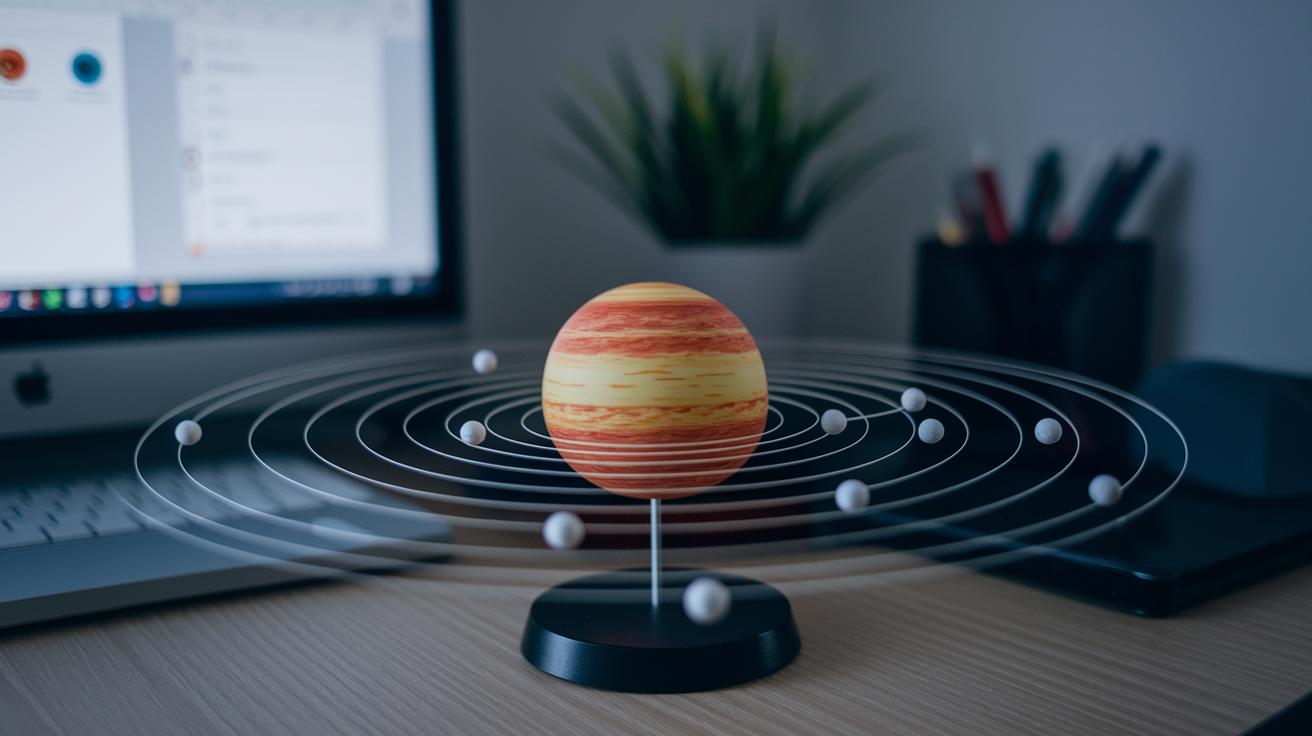
In 1543, Copernicus published De revolutionibus. He boldly placed the Sun at the center of the universe, sparking lively debates among scholars as they questioned old beliefs.
Between 1609 and 1619, Kepler shared his three laws of planetary motion. He revealed that planets move along oval paths instead of perfect circles. It’s like uncovering secret footprints that show the hidden order of the cosmos.
Then in 1687, Newton introduced his Principia. He connected the pull of gravity with the way planets move, much like fitting pieces into a grand cosmic puzzle.
In the early twentieth century, Einstein’s theory of general relativity added a new twist by showing how massive objects bend space. This idea gently adjusted our predictions of orbital motion near large celestial bodies.
More recently, in 2023, fresh research uncovered tidal-decay processes for exoplanets. This discovery reminds us that even modern observations can reshape our understanding of the universe.
Mathematical Modeling and Simulation of Planetary Orbits
Using computers, we can bring the dance of the planets right into view. Methods like Runge-Kutta and symplectic techniques work step-by-step to update a planet's position and speed. It’s a bit like drawing a picture by connecting dots, each tiny step adds up to a clear cosmic path.
Programs like REBOUND and Mercury let scientists play with different planetary settings. They can change starting spots and speeds to check if the system stays steady. Picking the right time-step matters a lot. For fast-moving satellites, seconds work best, while days suit the slow drift of planets. This mix of detail and ease keeps our models both accurate and manageable.
Still, even the best methods have their limits. Sometimes, in complex many-body systems, a small tweak can lead to a big and unpredictable change. And that, in its own way, makes the cosmos just as wonderfully mysterious as ever.
Final Words
In the action, we explored how celestial bodies move through space with beautiful clarity. The article walked through orbital mechanics, key gravitational forces, and historical milestones that shaped our view of planetary orbits.
Each section offered simple explanations and clear examples, from Mercury’s eccentric path to the fine details of Kepler’s laws. May these insights fill your day with cosmic wonder and brighten your way forward.
FAQ
What are planetary orbits and how are they arranged?
The planetary orbits refer to the paths planets follow around the Sun. They are ordered from the closest inner planets—Mercury, Venus, Earth, and Mars—to the outer giants, all kept in motion by gravity and inertia.
What is a geostationary orbit and how does it compare with geosynchronous orbit?
The geostationary orbit is a circular path over Earth’s equator where a satellite appears fixed in the sky. Geosynchronous orbits share this timing but might allow slight movement in position.
What is a sun synchronous orbit and why is it useful?
A sun synchronous orbit is a near-polar path that causes a satellite to pass the same area at nearly the same local solar time. This provides reliable lighting conditions for Earth monitoring.
What are Kepler’s three laws of planetary motion?
Kepler’s three laws state that planets orbit in ellipses with the Sun at one focus, sweep equal areas in equal time intervals, and have orbital periods that relate to the size of their orbits.
How is a planet’s orbit defined?
A planet’s orbit is defined by its elliptical path around a star, characterized by factors such as the semi-major axis, eccentricity, and orbital period, all shaped by gravitational forces.
How many major planets are in the solar system?
In our solar system, there are eight recognized major planets. Some lists add dwarf planets, but the core collection includes Mercury, Venus, Earth, Mars, Jupiter, Saturn, Uranus, and Neptune.