
Have you ever wondered why planets don’t travel in perfect circles? In truth, they often move in long, stretched ovals. This quality, called eccentricity, was first explained by Kepler. It shows us that sometimes a planet gets closer to the Sun and at other times it drifts further away. Here in our solar system, these shifting paths can change how much sunlight we receive and even affect the feel of the seasons. Today, let’s chat about how this simple number helps guide the graceful dance of the planets around our star. Isn’t it fascinating how the cosmos works?
Understanding Planetetary Eccentricity: Definition and Astronomical Significance
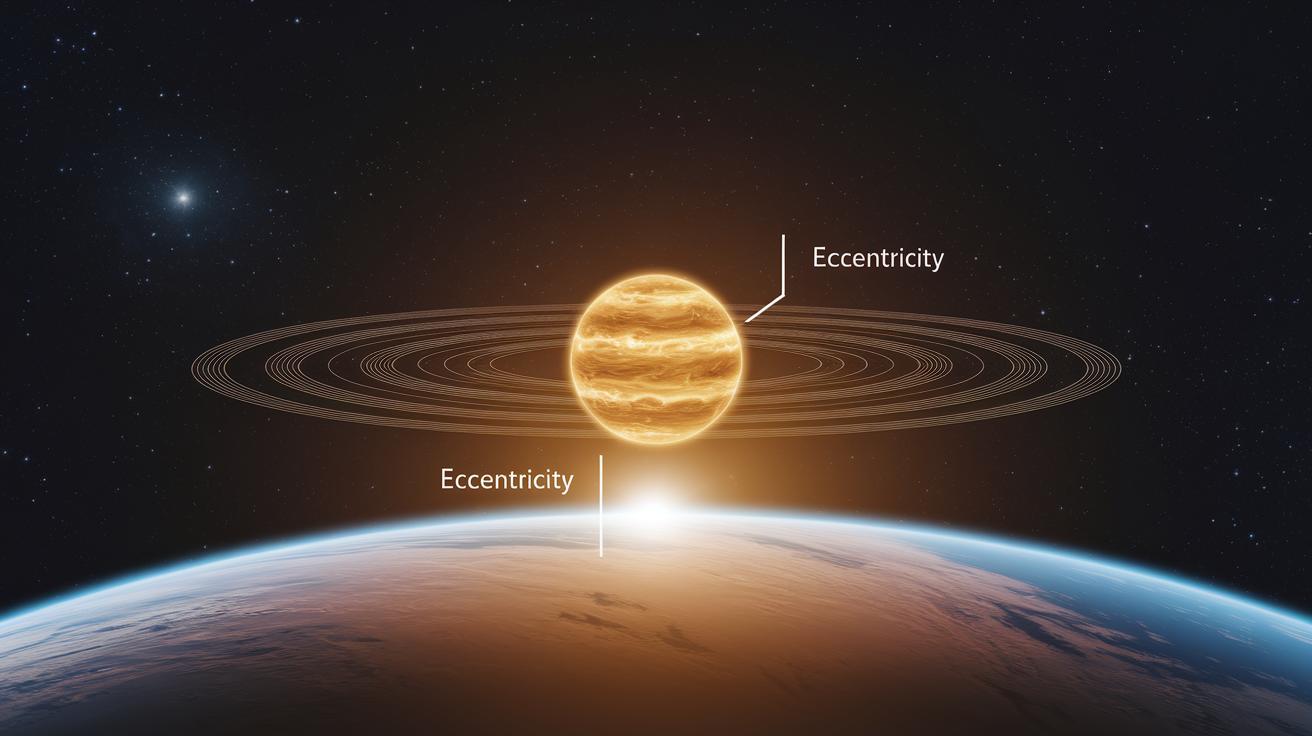
Planetary eccentricity shows us how much an orbit twists away from a perfect circle. Johannes Kepler told us that orbits look like ovals, where the Sun sits at one end. In simple words, eccentricity tells us how stretched out an orbit is. A circle has an eccentricity of 0, while a number closer to 1 means the orbit is much more stretched.
Imagine drawing a circle and then gently squeezing it until it turns into an oval. That squeeze is like what eccentricity means. Even though Earth seems steady, its slight oval orbit changes the sunlight we get ever so subtly. This tiny difference even plays a part in the seasons we feel throughout the year.
Eccentricity is not just a number. It helps us understand a planet’s journey in space. This number tells us how near a planet comes to the Sun at one point and how far it goes at another. Because of this, some planets seem to follow a smooth track, while others change their distance from the Sun quite a bit.
To see the idea clearly, picture two orbits. One stays almost the same distance from the Sun, while the other changes noticeably. These shapes give us clues about gravity and how other big objects in space might be tugging at the planets.
In the end, knowing how these orbits work helps us see how the rules of nature create the beautiful and steady patterns in our solar system.
Planetary eccentricity: Captivating Orbital Dynamics
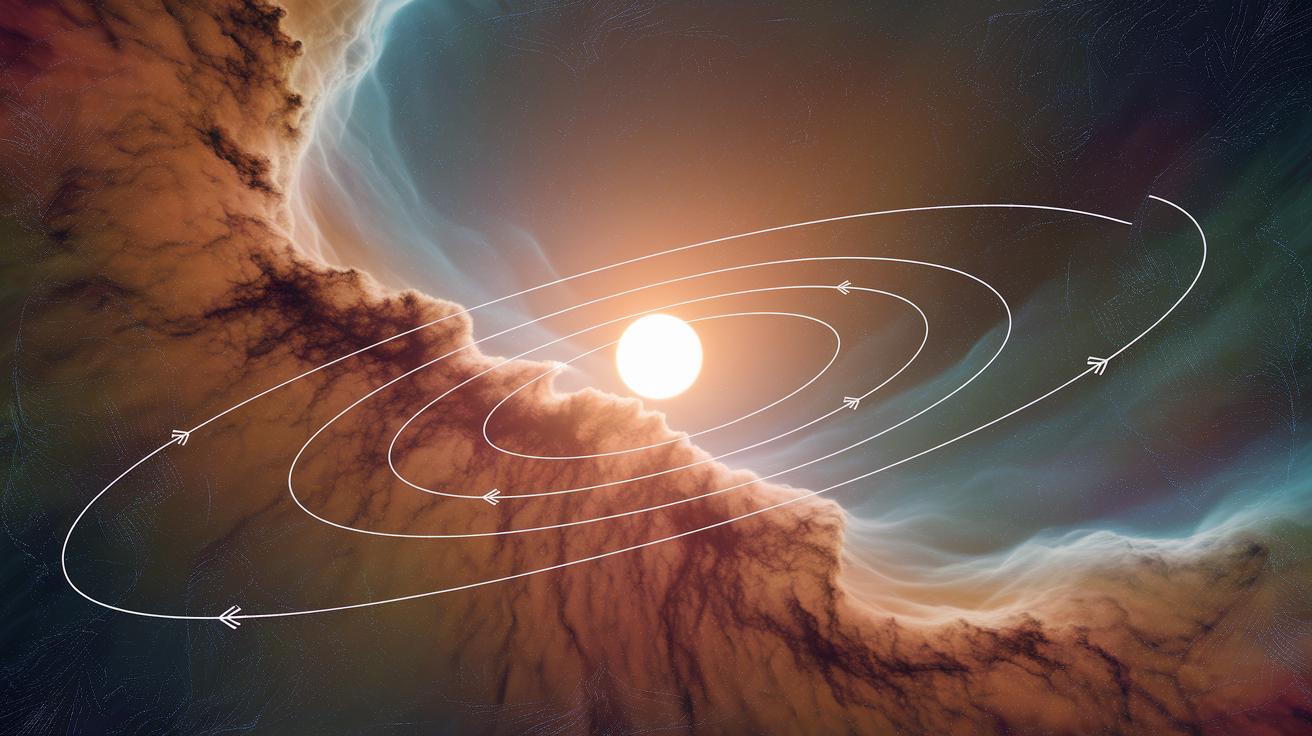
Planetary eccentricity shows how much a planet's path strays from a perfect circle, almost like drawing an oval instead of a circle. Kepler taught us that planets travel along elliptical paths with the Sun at one focus, which means a planet moves closer to and farther from the Sun as it orbits. This results in two important spots: one where the planet is nearest (perihelion) and another where it’s farthest (aphelion). Think of it like drawing an oval and noticing where it narrows and widens.
Gravitational forces play a big role in this cosmic dance. For instance, Earth's orbit gets a gentle stretch from big planets like Jupiter and Saturn. Their pull slowly shifts our distance from the Sun, and that’s one reason why our seasons change over time. One way to measure this stretch is by taking the difference between the aphelion and perihelion distances and dividing it by their sum. Even a small tug from a giant planet can change a smaller planet’s orbit enough to affect how much sunlight it gets each year.
These shifts and pulls help astronomers unlock the secrets of our solar system. By looking at how gravitational forces and distance changes work together, we get a clearer picture of the graceful movements of the planets.
Eccentricity Calculation Methods: Formulas and Conceptual Derivation

When you want to find out how stretched an orbit is, you can use a simple ratio. Take the difference between the farthest point (aphelion) and the closest point (perihelion) and then divide it by the sum of those two distances. If you remember our section on Planetary Eccentricity: Captivating Orbital Dynamics, you know the basics. Here, we break it down step by step with a clear example and a few extra tips.
Step-by-step process:
- First, note the distance when the planet is closest (perihelion) and when it is farthest (aphelion).
- Next, subtract the closest distance from the farthest.
- Finally, divide that number by the total of the two distances.
For example, if a planet is 152 million kilometers away at its farthest and 150 million kilometers at its closest, the math looks like this: (152 minus 150) divided by (152 plus 150). It’s interesting to think that even a 2-million-kilometer difference can really change how we see planetary motion.
For those who want a deeper understanding, sometimes you need to include how other planets tug on one another with gravity. These extra tweaks help you see a more accurate picture of a planet’s orbit as its distances change just a bit due to the pull from neighboring worlds.
| Step | Description |
|---|---|
| 1 | Find the closest (perihelion) and farthest (aphelion) distances |
| 2 | Subtract the closest distance from the farthest |
| 3 | Divide the result by the total of the two distances |
Eccentric Orbit Examples: From the Moon to Comets and Beyond

When we look at different space objects in our Solar System, it's amazing to see how their orbits change. The Moon, for example, travels in a nearly perfect circle with an eccentricity of 0.059. This means its closest and farthest distances from Earth are almost the same, so its journey stays smooth and steady.
On the other hand, many comets take much longer, stretched-out paths. Most comets have eccentricities between 0.2 and 0.7. In simple terms, when these comets swing close to the Sun (what we call perihelion) and then drift far away (aphelion), the difference in their distances is pretty big. For instance, Halley's Comet has an eccentricity of 0.967, showing just how dramatically its path can change.
| Object | Eccentricity |
|---|---|
| Moon | 0.059 |
| Typical Comets | 0.2 – 0.7 |
| Halley’s Comet | 0.967 |
These examples remind us how differences in the shape of an orbit can change how much sunlight a body gets during its orbit. It's another fascinating way the cosmos keeps us in awe.
Planetary eccentricity: Captivating Orbital Dynamics

The way Earth travels around the Sun can change how much sunlight different parts of our world get over long periods. When our orbit turns a little more oval, one part of the journey catches extra warmth, just like a dimmer switch brightening a room. And when Earth gets a bit closer to the Sun during its cycle, one side feels a sudden burst of light and heat.
This change in sunlight brings clear shifts in the seasons. When Earth nears the Sun, summers become much warmer. And when it swings away, winters turn noticeably cooler. Over the years, these changes mix with other weather factors to create the unique patterns we see in our climate.
Even a tiny change in the orbit can adjust how we experience each season. It's a gentle reminder that our planet’s balance of light and shadow is always being fine-tuned by the forces of the cosmos.
| Orbital Phase | Seasonal Impact |
|---|---|
| Closer to Sun | Warmer summers |
| Farther from Sun | Cooler winters |
Exoplanetary Eccentricity Trends: Insights from Distant Worlds
Many exoplanets follow stretched-out orbits that are very different from the nearly round paths we see at home. While Earth glides along a gentle circle, some distant worlds travel on long, narrow tracks. Take HD 20782 b in the Fornax constellation, for instance, it has an eccentricity of 0.956, which means its orbit is more like an elongated oval than a smooth circle.
These unusual orbits help us learn about how the planetary systems formed. High eccentricity might hint that something dynamic happened early on, like close encounters with other planets or tugging from a nearby star. When we compare these stretched-out orbits with the steady ones in our own system, we start to piece together the dramatic events that shaped these distant worlds.
Have you ever wondered what cosmic events might have nudged a planet into such an unpredictable journey?
Modeling Planetetary Eccentricity: Simulation Techniques and Software Tools

Astronomers run computer programs to watch how planet orbits slowly change over time. They use simple models to crunch numbers for orbital eccentricity, which is just a way of saying how stretched out a planet's path is. One tool they rely on is the n-body integrator. This neat tool calculates the pull between different space objects to show how a planet's orbit might twist and turn.
Simulation programs bring the dance of the planets to life. They create moving pictures of orbits so you can see slight shifts in the points where planets come closest or drift farthest away from their star. For instance, a simulation might reveal how Jupiter’s strong pull gently nudges Earth’s path. With these tools, experts can watch graphs trace the oval shapes of orbits over a long time, making it easier to compare changes.
| Tool | Application |
|---|---|
| N-body Integrator | Tracks gravitational influences |
| Data Visualization Software | Displays evolving orbital paths |
Imagine typing a simple line of code that draws a live graph of your planet’s shifting orbit. It looks almost like a moving canvas sprinkled with starlight, letting you witness the cosmic dance in action.
Final Words
In the action of exploring celestial mechanics, we moved from basic definitions of planetary eccentricity to the nuances of orbital calculations and how they shape climates. We explored orbits through examples that ranged from our near friend, the Moon, to distant exoplanets. Each section helped show how everyday cosmic patterns influence our skies. Let these insights spark wonder, guiding you with the rhythm of planetary eccentricity as a steady light in your daily cosmic exploration.
FAQ
What is the planetary eccentricity formula?
The planetary eccentricity formula measures how far an orbit deviates from a perfect circle by comparing the aphelion and perihelion distances.
What are the planets eccentricity in order?
The planets are typically ranked by their eccentricity from nearly circular to more elliptical, showing Earth’s almost circular path and Mercury’s noticeably stretched orbit.
What are some planetary eccentricity examples?
Planetary eccentricity examples include Earth’s nearly circular orbit, the Moon’s slight deviance, and the highly elongated paths seen in some comets.
What is the eccentricity of Earth?
The eccentricity of Earth is around 0.0167, meaning its orbit remains very close to a perfect circle with only a slight stretch.
What is the planetary eccentricity equation?
The planetary eccentricity equation comes from the differences between perihelion and aphelion distances, showing how much an orbit deviates from a circle.
Which planet has the most eccentric orbit?
Mercury exhibits the most eccentric orbit among the major planets in our solar system, meaning its path deviates more from a perfect circle.
What is the eccentricity of an orbit formula?
The eccentricity of an orbit formula calculates deviation by dividing the difference between aphelion and perihelion by their sum, quantifying the orbit’s shape.
What is the eccentricity of an ellipse?
The eccentricity of an ellipse indicates how elongated it is; a value of 0 means a perfect circle, while values approaching 1 signify a very stretched shape.
What is planet eccentricity?
Planet eccentricity shows how much a planet’s orbit departs from being perfectly circular, offering insight into its orbital shape and dynamics.
Which planet has the highest eccentricity?
Mercury is known to have the highest eccentricity in our solar system, giving it a noticeably stretched orbital path compared to a circle.
Is 0 or 1 more eccentric?
An eccentricity of 0 is completely circular, while an eccentricity close to 1 is far more eccentric due to its highly elongated orbit.
What does eccentricity mean in the solar system?
Eccentricity in the solar system measures how non-circular an orbit is, helping us understand the dynamic motion and arrangement of planets and other bodies.