
Have you ever wondered why planets, moons, and comets captivate us so much? Imagine our Solar System as a giant clock, with each piece moving to its own steady beat. Scientists use three simple steps to sort these space wonders, making them easier for us to understand. When you look at Earth and its neighbors, you see these celestial bodies dancing in the night sky, always inviting new ideas about our cosmic home. In this piece, we'll explore these easy checks and uncover the magic behind the incredible objects that orbit our Sun.
Planetary Bodies Defined: Criteria for Classification
Planetary bodies are moving objects out in space. They include Earth, its fellow planets, moons, and comets as they orbit the Sun. Scientists use clear rules to sort these objects into groups. The International Astronomical Union gives us three simple checks: the object must circle the Sun, be big enough that its gravity makes it round, and have cleared its path of other space debris.
Take Earth for instance. It circles the Sun, is nearly round, and lives in a space that is mostly clear. Using these checks, scientists sort objects into planets, dwarf planets, and small Solar System bodies. Planets pass all three tests, while dwarf planets only look round and don’t clear their neighborhoods. Smaller objects like asteroids and comets don’t meet all these conditions.
These rules let scientists sort our Solar System accurately. They help us see the differences between space objects and keep our view of the cosmos neat. In short, they make understanding our ever-moving cosmic neighbors much simpler.
Planetary Bodies in the Solar System: Structure and Regions
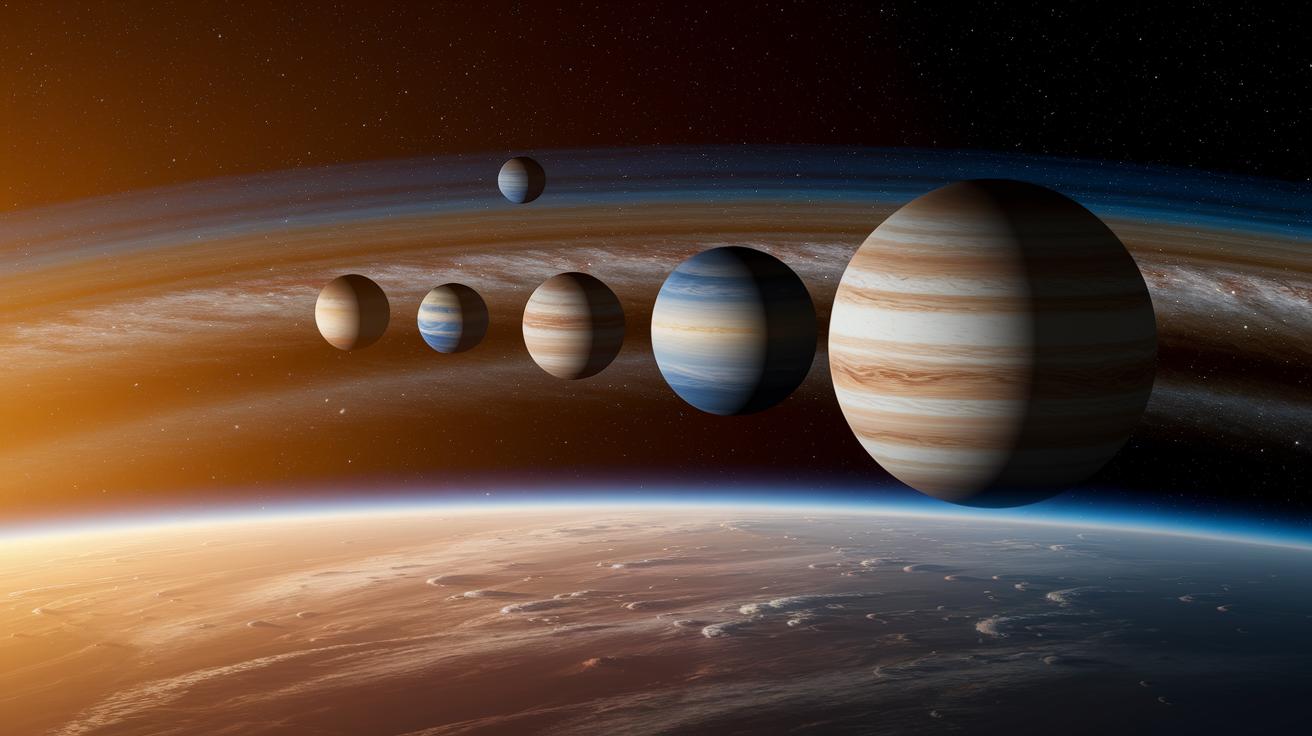
Deep in the heart of our Solar System lies the inner terrestrial zone. In this cozy enclave, rocky worlds like Mercury, Venus, Earth, and Mars spin around the Sun with tightly packed, sturdy structures warmed by intense solar heat. Next, we travel to the asteroid belt, a vast ring filled with space rocks left over from the early days of planet formation. Scientists dig into these clues to understand how the building blocks of planets came together.
Recent views from the Subaru Telescope have sparked new excitement. Several mysterious bodies have been spotted beyond the well-known Kuiper Belt, which fits with what NASA’s New Horizons mission discovered around Neptune. Out here, gas giants mingle with icy objects in a far-off zone that still hides many secrets. Inside our solar home, dense and heavy matter gives way to a spread-out mix of lighter, frozen debris.
Every region in our Solar System tells its own story. Unique forces and unfolding events have shaped these cosmic landscapes, offering us a glimpse into the ever-evolving wonder of our celestial neighborhood. Have you ever marveled at how different parts of space come together to form such an amazing picture?
| Zone | Characteristics | Mass Distribution |
|---|---|---|
| Inner Terrestrial | Rocky planets with thin atmospheres | High density, compact bodies |
| Asteroid Belt | Orbiting rocks from early formation | Moderate density, uneven spread |
| Outer Regions | Gas giants, Kuiper Belt, scattered disk objects | Lower density, dispersed icy materials |
Types of Planetary Bodies: Terrestrial to Dwarf Planets
The Solar System is full of wonder with many types of planets. Terrestrial planets are small, rocky places with thin atmospheres. Think of Mercury, Venus, Earth, and Mars as worlds where you can see hints of weather and slow changes over time.
Gas giants are a whole different story. These huge planets, like Jupiter and Saturn, are wrapped in deep layers of hydrogen and helium. Their storms swirl in a mix of gases around a tiny core, creating a dance of ever-changing clouds.
Then there are the ice giants. Planets such as Uranus and Neptune hold cool blends of water and ammonia deep inside. Their chilly interiors offer clues about how planets far from the Sun can be unique and enchanting.
Dwarf planets remind us that not every round world clears its path. Even though they share a similar shape to bigger planets, they still wander among smaller bits of space dust.
Small bodies like asteroids, meteorites, and comets also add their own sparkle to our cosmic family.
| Planet Type | Main Features |
|---|---|
| Terrestrial | Rocky surfaces and thin atmospheres |
| Gas Giants | Deep layers of hydrogen and helium around a small core |
| Ice Giants | Cool interiors rich in water and ammonia |
| Dwarf Planets | Rounded shape but share space with debris |
Each type teaches us more about how planets form and change, just like reading a secret diary written in starlight.
Orbital Dynamics of Planetary Bodies: Stability and Motion

Celestial objects like planets move in gentle, predictable loops around the Sun. Kepler’s laws help us see the simple patterns in their motion, making it easier to understand their graceful dance. Planets travel in oval paths and move faster when they are closer to the Sun, and slower when they are farther away. When researchers spot new objects in distant parts of space, they often notice that a kind of gravitational "tug-of-war" helps keep these paths steady.
When we study these orbits, we look at both their shape and how they tilt in space. The measure of an orbit’s stretch, known as eccentricity, tells us if the path is nearly round or more like a stretched-out oval. A nearly round orbit has a low eccentricity, while a more extended path has a higher one. How much an orbit tilts can reveal hints about past cosmic events and the pull of nearby bodies. These details remind us that even among the vastness of space, gentle forces work together to keep everything in balance.
| Planet | Semi-Major Axis (AU) | Eccentricity |
|---|---|---|
| Mercury | 0.39 | 0.21 |
| Earth | 1.00 | 0.02 |
| Mars | 1.52 | 0.09 |
Even though each planet follows its own special path, the same simple forces guide them all. The steady pull of gravity and these natural rhythms show us how a cosmic balance can exist in a crowded space, much like the gentle harmony of a star-filled night.
Planetary bodies: Captivating Cosmic Science
The tale of how planets are born starts with a huge, swirling mix of gas and dust. New research tells us that the early solar cloud was much bigger than we once believed. This insight has changed our thinking about how planets form because it means there was a lot more material spread out over space than older ideas suggested.
As tiny bits in this gigantic cloud began to stick together, the journey of creating worlds got underway. Over time, little clumps of dust merged into bigger bodies. Soon enough, gravity pulled these objects into smoother, rounder shapes. Scientists have used computer models and dating techniques to learn just how quickly these particles can settle into separate layers.
We now have clever ways to peek inside these mysterious worlds. By matching up different models, researchers are slowly piecing together how cores, mantles, and crusts take shape in new planets. In short, there is strong evidence that a slow process built a heavy core, wrapped in lighter layers.
The evolution of a planet's core also grabs our attention. Radioactive decay and leftover heat from the planet's birth probably kept its inner workings active long after it formed. This steady heat helped change the chemical makeup of these new planets and gives us hints on why different planets might look so different even if they started out the same way.
All of this invites us to look at our ideas with fresh eyes. The dance of gathering, mixing, and heating has a big part to play in forming the many faces of planets in our cosmic neighborhood.
Exploration and Discovery of Planetary Bodies

Have you ever marveled at how our view of the sky has grown? Ground-based telescopes, space probes, and fresh survey methods now let us see planets and other cosmic wonders like never before. The Subaru Telescope, for example, has shown us objects lying way past the Kuiper Belt. And then NASA’s New Horizons mission added its own magic, capturing detailed views of far-off space. It’s clear that exploring the cosmos takes a team of amazing tools working together.
Astronomers use techniques like transit photometry. That means they watch for tiny dips in a star's brightness when an exoplanet crosses in front of it. They also take direct images of these distant worlds, snapping real pictures from across the universe. And by noticing small wobbles in stars, thanks to the radial velocity method, they can even detect planets that might otherwise hide. This smart mix of methods has helped researchers discover thousands of exoplanets and learn about their special traits.
New star-gazing tools, like next-generation ground arrays and the James Webb Space Telescope, promise even clearer views and more precise details. These advancements make our cosmic hunt sharper and more exciting.
- Ground-based telescopes let us reach further.
- Space probes capture secrets from far away.
- Techniques like transit photometry, direct imaging, and radial velocity uncover hidden planets.
- Future missions will keep opening new chapters in our cosmic story.
Each method is a new window into the universe, bringing us closer to understanding the vast, wonderful gallery of planets and stars around us.
Final Words
In the action, this article raced through the science behind classifying planetary bodies and exploring their dynamic motion. It explained how we group these objects by examining their structure, movement, and core formation.
Each section painted a clear picture of our space neighborhood with straightforward insights and modern techniques. The mix of ancient wisdom and current research leaves us feeling guided and empowered to see the beauty in every cosmic dance of planetary bodies.
FAQ
What are planetary bodies in our solar system?
Planetary bodies in our solar system refer to objects like planets, dwarf planets, moons, asteroids, and comets that orbit the Sun and are classified based on set scientific criteria.
What does the planetary bodies crossword clue hint at?
The planetary bodies crossword clue hints at objects from our solar system, such as Mars, Venus, or Pluto, known for their recognized positions or unique characteristics.
What does a planetary bodies diagram illustrate?
A planetary bodies diagram illustrates the layout of the Sun and solar system objects, showing how planets and other bodies orbit, along with their relative distances and movement paths.
What are some common planetary bodies names?
Common planetary bodies names include Mercury, Venus, Earth, Mars, Jupiter, Saturn, Uranus, Neptune, and notable dwarf planets like Pluto, which are recognized by astronomers.
Can you give a planetary body example?
A planetary body example is Earth, a nearly round object that orbits the Sun, meeting the criteria for shape and orbital dynamics as defined by science.
Is the Moon a planetary body?
The Moon is not a planetary body; it is a natural satellite because it orbits Earth rather than directly orbiting the Sun.
What are some examples of celestial bodies?
Celestial body examples include stars like the Sun, planets such as Earth, and natural satellites, each defined by their distinct roles and motion patterns in space.
Is the Sun considered a planetary body?
The Sun is not considered a planetary body; it is a star that serves as the central hub of our solar system, providing the necessary gravitational force for orbiting objects.
What is the meaning of planetary bodies?
The meaning of planetary bodies involves objects that orbit the Sun and are categorized by attributes like shape, gravity, and orbital behaviors, following established astronomical criteria.
How many planetary bodies are there?
There are eight recognized planets along with several dwarf planets and countless smaller bodies, all contributing to the diverse collection of objects in our solar system.
What are the 4 types of celestial bodies?
The four types of celestial bodies can be seen as stars, planets, moons, and smaller space objects like asteroids, each playing a distinct role in the makeup of our universe.
What are the 9 celestial bodies?
The term 9 celestial bodies traditionally refers to the nine planets of our solar system, including Pluto, which was once considered the ninth planet before reclassification.