
Have you ever noticed how planets seem to drift along a magical path across the sky?
They move around the sun like runners on a track, each taking its own unique path.
Long ago, people believed the stars were stuck in the same spot until smart thinkers turned that idea around.
Now we see that every planet adds its own steady beat to our cosmic dance.
In this post, we're sharing ideas that clear up the secret order behind these celestial moves.
It’s like catching a glimpse of the gentle shimmer of starlight that quietly guides us every night.
Planetary Motion Overview: Foundations of Celestial Paths
Before telescopes, people believed the stars simply hung in place, unaware of the dynamic celestial motions that shape our sky. But planets move around the Sun like runners on a track, each with its own path. Picture the heliocentric model: the Sun shines at the center while the planets glide around it, much like a carousel with the Sun front and center. This idea changed our whole view of the universe.
Copernicus turned old beliefs upside down in 1543 with his work De revolutionibus. He showed that Earth wasn’t the center at all. Instead, he argued that all the planets, including ours, orbit the Sun. This new way of thinking opened exciting doors to understanding the cosmos.
Then came Galileo and his telescopic discoveries in 1610. When he saw the phases of Venus and found four moons circling Jupiter, he proved that not every celestial body dances around the Earth. His fresh observations confirmed that each planet follows its own path in space.
Have you heard of an orbital period? It’s the time a planet needs to make one full circle around the Sun. Think of it like running a lap on your favorite track, the time it takes is unique, just like every planet’s elliptical (oval-shaped) path is. Every orbit has its own twist, creating a cosmic dance full of rhythm and wonder.
Mechanics of Planetary Orbits: Kepler’s Laws and Newtonian Force Fields
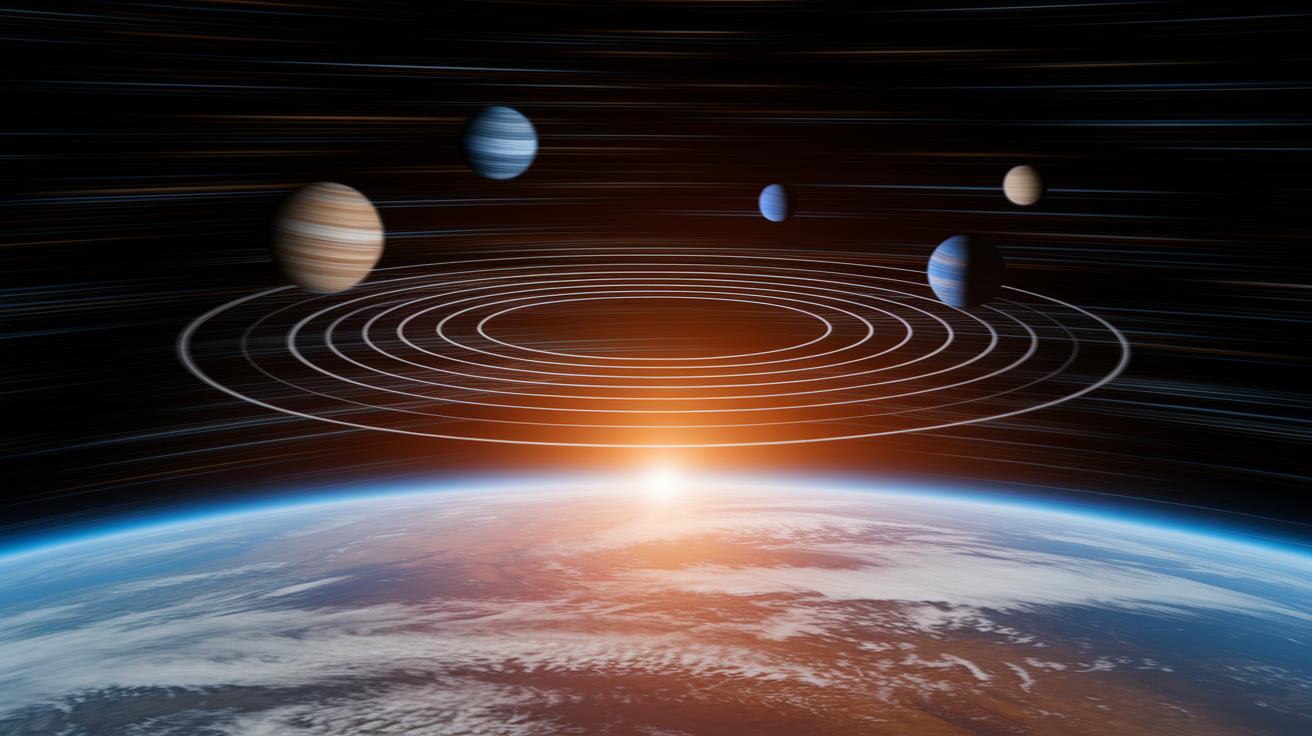
Picture the planets gracefully orbiting our sun while following natural rules. Kepler discovered that their paths are not perfect circles but stretched-out ovals. Think of it like running on an oval track where the finish isn’t exactly in the center.
Kepler's second law adds a delightful twist. It tells us that a planet sweeps out equal areas in equal times. This means that when a planet is closer to the sun, it speeds up, and when it is farther away, it slows down. Imagine a runner who sprints on the straight parts and eases up on the curves.
Kepler's third law connects time and distance. In simple words, planets that are farther away from the sun take much longer to finish an orbit, much like comparing a quick dash to a long marathon.
Then, Isaac Newton joined the scene with his insights about gravity. His law of universal gravitation shows that every object pulls on every other one. It’s this pull that keeps the planets moving in organized, predictable paths.
| Law | Description | Formula |
|---|---|---|
| Kepler’s First Law | Planets move in elliptical orbits with the sun at one focus | – |
| Kepler’s Second Law | Planets sweep equal areas in equal times | – |
| Kepler’s Third Law | The square of the period is proportional to the cube of the semi-major axis | T² = a³ (using years and astronomical units) |
Together, these ideas and Newton’s force field create a picture of our solar system as a perfectly timed dance, with each planet moving in sync to the cosmic rhythm.
Planetary Gravitational Interactions: Resonant Cycles and Multi-Body Dynamics
Everywhere in our solar system, gravity is quietly guiding planets along their paths, setting up delicate dances between them. When two bodies pull on each other on a regular basis, they often start moving in sync. For example, Pluto and Neptune perform a cosmic duet where Pluto orbits twice for every three orbits of Neptune.
When more than two bodies join the dance, things get extra interesting. A giant like Jupiter can gently shape the journeys of smaller objects, much like an artist molding clay. These little nudges can slowly change an object’s speed or direction, and over time, the shifts become big enough to notice.
Consider these examples of gravity in action:
- Neptune and Pluto groove in a 3:2 rhythm.
- Jupiter and Saturn nearly move together in a 5:2 rhythm.
- Tiny moons like Mimas and Pandora help guide Saturn’s rings.
Each of these cases shows us how gravity sets a rhythmic waltz among the stars. All these subtle pulls keep our solar system balanced, with each planet and satellite gently influencing another in a beautiful cosmic harmony.
Observational Methods in Space: Tracking Planetary Transits and Retrograde Phenomena

Astronomers study planets by watching for tiny changes in starlight and shifts in color. One way they do this is by looking for small dark spots on a star when a planet passes in front. For instance, the planet HD 209458 b crosses its star every 3.5 days, causing a gentle dip in brightness that shows us its size and orbit. It’s a bit like seeing a small shadow slide over a bright light.
Transit Photometry
This method is all about noticing the soft dimming of a star when a planet moves across it. Picture a little object gliding in front of a streetlamp at night. The tiny decreases in brightness tell us about the planet, like its size and the path it follows as it journeys around its star.
Radial Velocity Measurements
Here, scientists pay close attention to a star’s light. When a planet circles its star, its gravity pulls the star ever so slightly, causing a subtle wobble. This wobble shifts the light toward blue and red, much like listening to a tune that gently changes pitch. It was this method that helped uncover the planet 51 Pegasi b, showing that even gentle tugs can point us to a new world.
Pulsar Timing Techniques
Pulsars are like nature’s perfect clocks, sending out regular pulses of light. When a planet orbits a pulsar, the timing of these pulses shifts a little bit. These tiny changes helped scientists find Earth-sized planets around PSR B1257+12, proving that even in the most extreme corners of space, planets can still shine through.
During the Kepler Space Telescope mission, researchers kept an eye on more than 150,000 stars. Their careful observations led to the discovery of over 2,600 exoplanets. Each method gives us a special glimpse into the cosmic dance of these distant worlds, filling us with wonder about the universe.
Modeling Planetetary Trajectories: Computational Dynamics and Analytical Simulations
Scientists use computer models to trace the paths of planets over many years. They run N-body simulations, which use methods like Runge-Kutta integration, to show how our solar system might change as time goes by. Imagine a friendly program that calculates the pull between hundreds of objects, each one gently nudging the others, like instruments in a cosmic orchestra.
Math models help bring a clear structure to these simulations. Researchers use simple formulas to compare telescope data with what the computer predicts. Think of it as putting together a puzzle, when a simulation suggests an orbital shift, they check the night sky for the same pattern.
Finding patterns in the sky is very important. Clever algorithms go through huge amounts of data to spot repeating routes. They match these known patterns with the simulation results to fine-tune the models. This mix of computer work and direct observation gives us a deeper peek into the universe. It’s like having a map that shows both the well-traveled roads and hidden trails, revealing a secret path to a favorite spot.
These computational tools connect theory with what we see, offering clear cosmic insights that help us understand the ongoing dance of the stars.
Historical Planetary Models: From Geocentric Views to Heliocentric Acceptance

Long ago, people believed that Earth sat at the center of the universe. This idea set the stage for amazing discoveries about how the stars move.
Then, our view shifted to a Sun-centered system. Copernicus proposed this in 1543, and in 1610, Galileo's new telescope offered clear proof. These insights gave us a fresh, true picture of the sky.
This new perspective even made sea charts better. Picture a captain on a calm, moonlit night. He noticed a bright star gently shifting its spot and used that tiny change to guide his journey across the ocean.
Exoplanetary Dynamics: Extending Orbital Mechanics Beyond the Solar System
Kepler's data first opened our eyes by revealing thousands of distant planets among tens of thousands of stars. Today, powerful tools like the James Webb Space Telescope (JWST) help us see even more clearly. JWST lets us peek into the gentle layers of exoplanet atmospheres and map their orbits with surprising detail. Imagine the soft twinkle of a far-off planet, its orbit sketching a cosmic design in the dark sky.
TESS scans nearly the whole sky, catching the tiny dimming of starlight as planets pass by. This delicate rhythm shows us how a star's pull blends with a planet's unique path, creating its own cosmic dance. Each twist tells its own tale, deepening our understanding of the vast mechanics of interstellar travel.
Final Words
In the action, the article traced how celestial bodies orbit under a heliocentric view, explored Kepler’s and Newton’s rules, and highlighted the role of telescopes in spotting subtle transits. Each piece offered a clear take on models from ancient systems to cutting-edge exoplanet research.
Every section sheds light on steps we take to find our way through the cosmos. May this insight guide you gently while deciphering the dance of the planets.
FAQ
What is the dance of the planets?
The dance of the planets describes how each planet moves gracefully around the Sun along elliptical paths, influenced by gravity. It captures the natural, coordinated motion observed by astronomers over centuries.
What is the rhyme for the 9 planets remembering?
The rhyme for remembering the nine planets is often rendered as “My very educated mother just served us nine pizzas,” which helps recall the order of the planets from the Sun outward.
How often do all 8 planets align?
The alignment of all eight planets is extremely rare. Although some planets may line up occasionally, a complete alignment does not follow a regular pattern within our human timeframe.
What does the Bible say about the planets?
The Bible offers poetic language referring to the heavens and celestial bodies but does not provide a detailed or scientific explanation of planetary motion.